Soft Focus — Focus
ADHD productivity tools that aren’t just “try harder”
The standard advice is a to-do list and more discipline. If that worked, you would not be reading this. What follows changes the conditions rather than the person.
Most productivity systems are built by people for whom starting is easy. They optimise the middle — prioritisation, batching, weekly reviews — and assume the beginning takes care of itself. For a lot of people it does not, and no amount of reorganising the list fixes that.
The tools below work on a different principle. They make time visible, make the environment quieter, or take the decision out of your hands. None of them require you to want it more.
Make time visible
Time blindness is the least discussed and most disruptive part of this. Not poor time management — a genuine difficulty perceiving how much time has passed or how much remains. Twenty minutes and two hours feel similar from the inside.
A digital clock does not help, because reading 3:47 requires you to do a calculation. A visual timer helps because the remaining time is a shape, not a number. You see a quantity shrinking.
FILP Pomodoro Timer, silent + alarm
Flip it to the interval you want and it starts — no menus, no phone. The silent mode matters if you share a room; the vibration is enough to register without announcing itself.
The pomodoro interval itself is less important than people insist. Twenty-five minutes is a convention, not a finding. What matters is that the session has a visible end, because a task with no boundary is much harder to begin.
Set the timer for less time than you think the task needs. The goal is not to finish inside it — the goal is to make starting cheap. A five-minute commitment is one you will actually make, and starting is nearly always the entire problem.
Take the noise away
Open-plan rooms, thin walls, other people at home. Distractibility is not a character flaw when the environment is genuinely loud, and the two fixes work differently enough that it is worth knowing which one you need.
Ear muffs remove sound. They are passive, need no charging, and they are what you want when the noise is intermittent — a conversation, a television, someone on a call in the next room.
Pro For Sho 34dB NRR Ear Muffs
34dB NRR, the highest passive rating in a compact shell, and 26,000+ reviews behind it. Unglamorous industrial kit that does the job better than anything marketed as a focus product.
A white noise machine does the opposite: it adds a constant sound that masks the variable one. That suits a steady background problem — traffic, a hum through a wall, a house that is never quite silent.
White Noise Machine for Office Privacy
Sized for a desk rather than a nursery, which most of this category is not. Masks conversation through a wall without becoming the thing you notice.
If neither appeals, reusable earplugs sit between the two — they drop a room by roughly 24 dB while leaving speech intelligible, which is what cheap foam plugs get wrong.
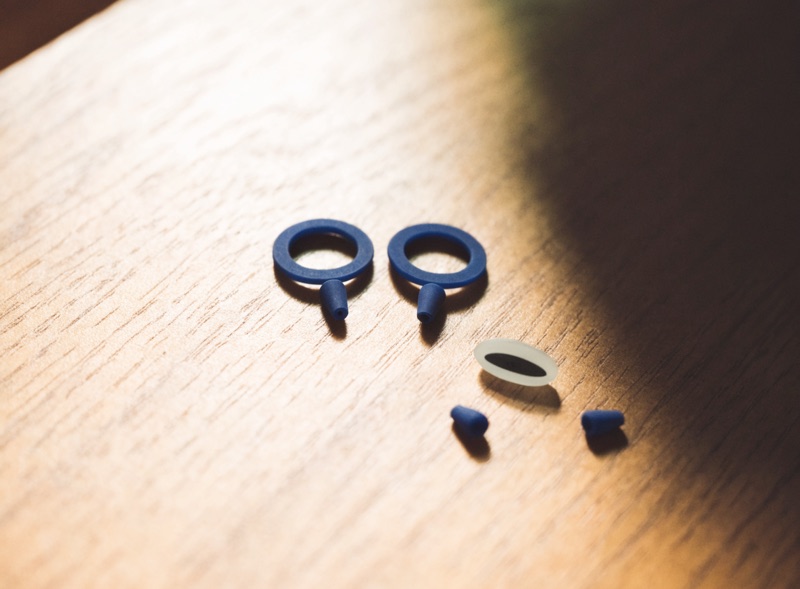
Loop Quiet 2 Earplugs
Not earbuds. Nothing pairs, nothing plays, nothing needs charging. For open rooms and houses with people in them.
Get it out of your head and onto paper
Digital task managers have a specific failure mode here: the app is on the same device as everything else competing for your attention. Opening it to write one task means passing three notifications.
Paper does not have that problem, and the physical act of writing appears to help retention in a way typing does not. The objection to paper is that it accumulates — which is what reusable notebooks solve.
Rocketbook Pro Reusable Notebook, 8.5×11
Write, scan to wherever you keep things, wipe, reuse. The page is gone but the note is filed, which removes the pile without removing the paper.
For structure rather than blank pages, an undated planner avoids the trap of dated ones — you can start today, and a missed fortnight does not leave you staring at abandoned pages.
ADHD Daily Planner, undated
Undated, task-first rather than hour-first, and cheap enough that abandoning it costs nothing. Built around brain dumps and priorities rather than a rigid daily grid.
What none of this fixes
These are environmental supports, not treatment. They lower the cost of starting and reduce the noise competing for attention — that is a real and useful thing, and it is also a limited one.
If focus is genuinely disrupting work or life, the tools are worth having and they are not a substitute for talking to someone qualified about it. Anyone selling you a $30 timer as the answer is selling you a $30 timer.
The Home Office Setup Guide
Eighteen pages: the six measurements with a printable worksheet, three complete builds with every piece listed, a lighting plan for awkward rooms, and small-desk layouts. Free.
Get the guide